
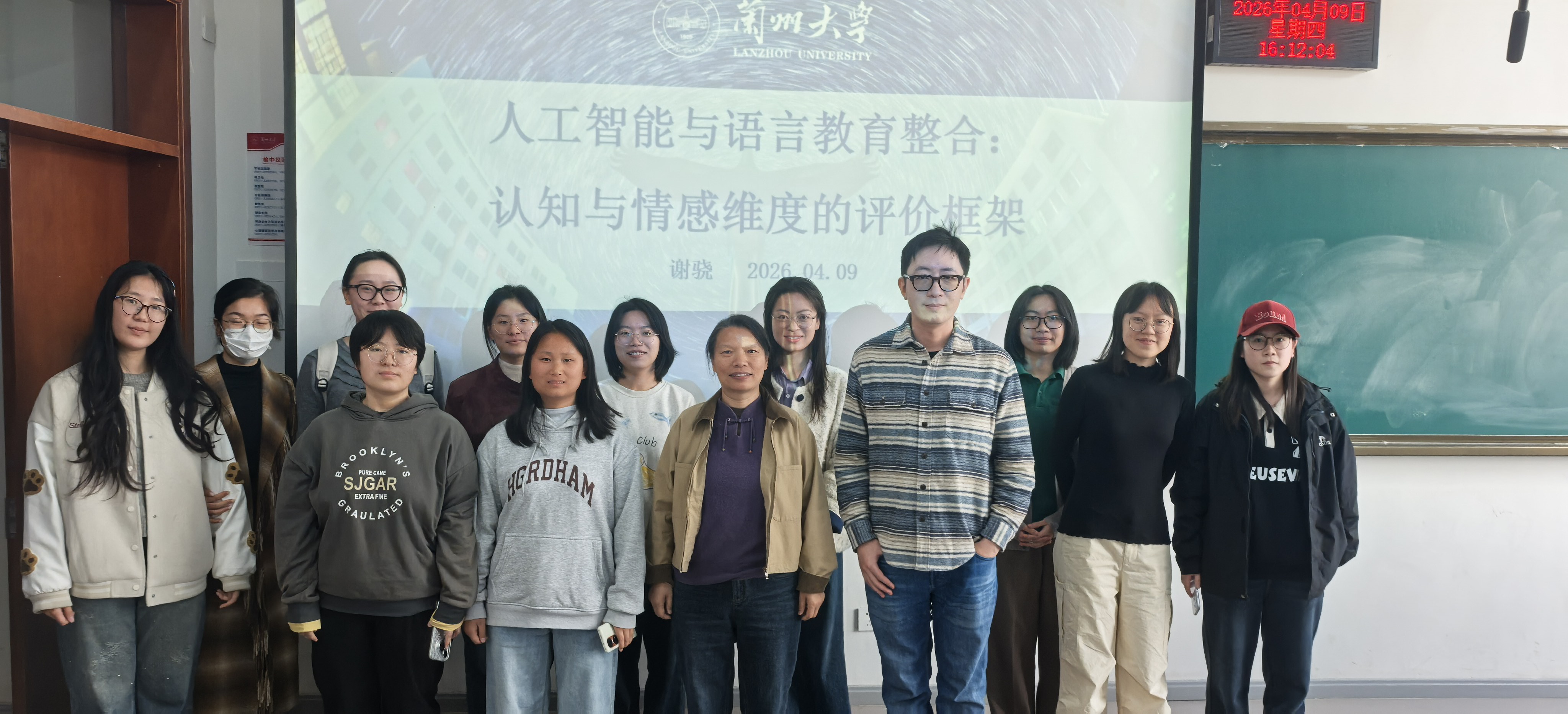
To promote the deep integration of artificial intelligence technology into foreign language education and broaden the academic horizons of faculty and students, the Institute of Foreign Linguistics and Applied Linguistics invited Associate Professor Xie Xiao to deliver a special academic lecture on April 9. The lecture was titled “Integrating Artificial Intelligence into Language Education: An Evaluation Framework from Cognitive and Affective Dimensions”. It was chaired by Professor Luo Na, Director of the Institute, and was well attended by faculty and students from the School of Foreign Languages and Literatures and other schools across the university.
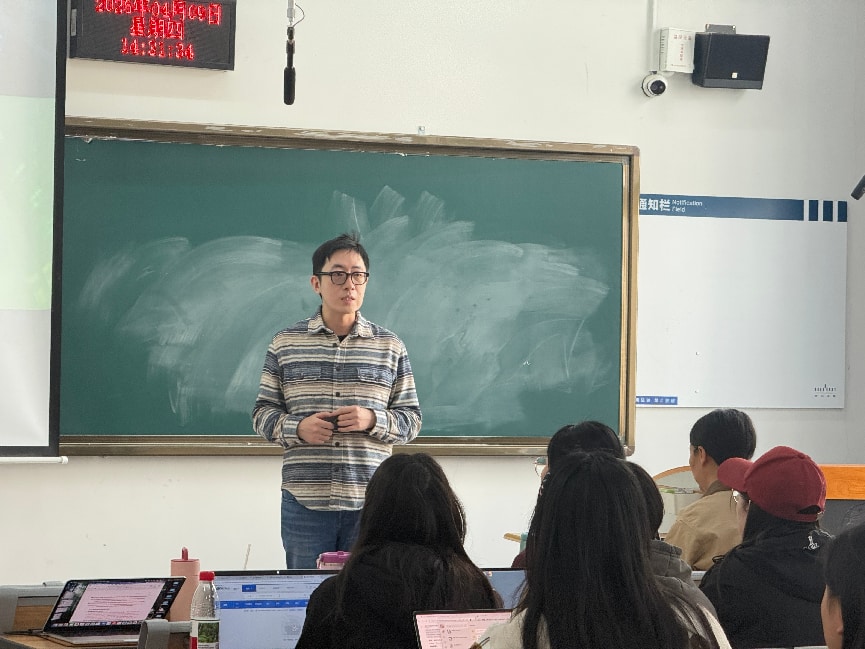
Focusing on the core issue of “language teachers’ AI literacy and AI?induced emotions”, Xie Xiao systematically examined three major academic databases, Web of Science, Scopus, and ProQuest, following the PRISMA guidelines. He elaborated on the core components of language teachers’ AI literacy, identifying five key dimensions: AI knowledge, pedagogical application, prompt literacy, ethical considerations, and professional development needs. Based on an analysis of 22 empirical studies, Xie noted that most language teachers currently possess a foundational level of AI literacy covering four core areas: basic knowledge, classroom application, critical evaluation, and ethical understanding. Drawing on 12 related studies, he also revealed that the integration of AI into language teaching triggers a range of emotional responses among teachers, including feelings of challenge, intimidation, loss, and achievement.
Furthermore, Xie introduced an innovative conceptual framework grounded in appraisal theory to analyze the interactive mechanism between cognition and emotion. He explained how teachers’ primary appraisals of AI (as a threat, challenge, or opportunity) and secondary appraisals (assessment of coping resources) jointly generate different emotional responses. He suggested that while relevant departments focus on enhancing teachers’ competence in using AI tools, equal attention should be paid to providing emotional support to effectively alleviate the pressures and challenges associated with technology integration.
In her concluding remarks, Professor Luo Na expressed sincere thanks to Associate Professor Xie Xiao for his insightful lecture. Drawing on her own teaching and learning experiences, she encouraged students of foreign language majors to pay attention to emotion management in language learning, to persist in daily practice, and to solidly improve their oral proficiency. She stressed that professional competence can be enhanced through both the empowerment of technology and diligent study. The lecture focused on a cutting-edge academic topic, with both theoretical depth and practical guidance, and provided new ideas and directions for exploring innovative development in language education in the context of artificial intelligence.
Add: School of Foreign Languages and Literatures, Lanzhou University,
West Donggang Road, 199, Lanzhou, Gansu, P. R. China, 730000
Tel: 0931-8912270
E-mail: shitr@lzu.edu.cn
Fax: 0931-8912270

Copyright: School of Foreign Languages and Literatures, Lanzhou University
Address: School of Foreign Languages and Literatures, Lanzhou University, South Tianshui Road, 222, Lanzhou, Gansu, P. R. China, 730000